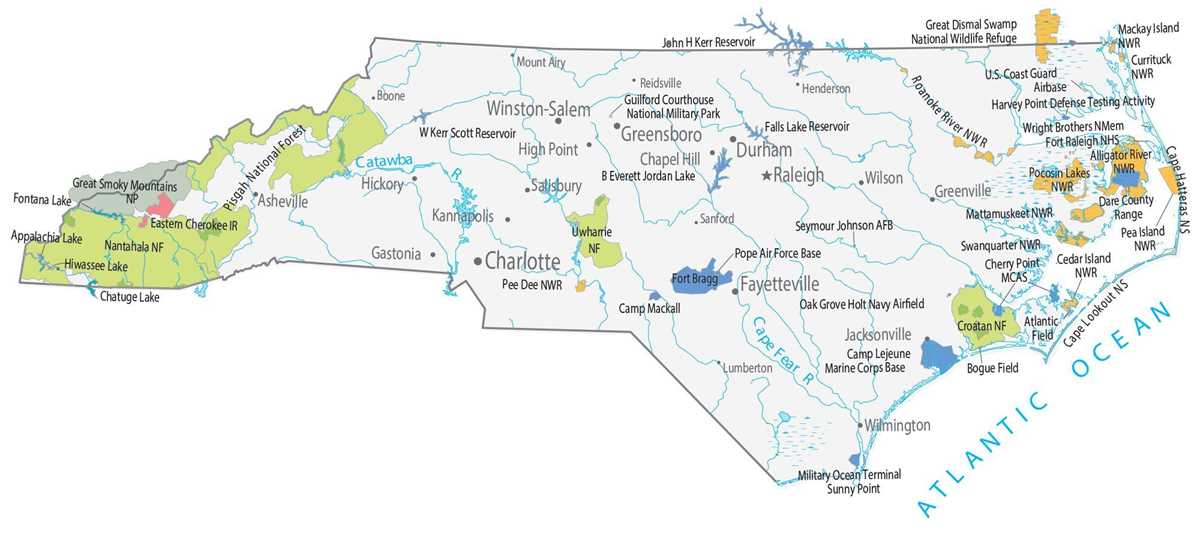
Choose a high resolution PDF version sized for standard Letter or A4 paper so roads, county borders, and city names remain sharp after output.
Geographic Details to Include
Administrative Boundaries
- All 100 counties with clearly drawn border lines
- Major municipalities such as Charlotte, Raleigh, Greensboro, and Asheville labeled with larger type
- State boundary highlighted with a thicker stroke for quick identification
Transportation Network
- Interstates including I-40, I-85, I-77, and I-95 marked with shield symbols
- Primary highways shown using thinner secondary lines
- Distance scale displayed in miles for trip planning
Physical Features
- Blue Ridge Mountains indicated through shaded relief in the western region
- Rivers such as the Cape Fear and Neuse drawn in contrasting color
- Coastal plain and barrier islands clearly outlined along the Atlantic edge
Formatting for Clean Paper Output
Set margins no smaller than 0.5 inches to prevent clipping during home or office reproduction. Use landscape orientation to preserve proportional width across the state’s long east-west span.
- Resolution: At least 300 DPI to avoid blurred labels
- Color Mode: Light color palette that remains readable in grayscale
- Legend Placement: Bottom corner to avoid covering geographic content
- Grid Option: Add latitude and longitude ticks for classroom reference
- File Size: Keep under 10 MB for quick download and sharing
This format supports travel preparation, education, logistics planning, and offline navigation where digital access is limited.
Printable Map of North Carolina Layout Details and Practical Applications
Select a horizontal layout that matches the state’s wide geography so western mountains and eastern coastline appear without compression or distortion.
Use a scale between 1 to 1.2 million and 1 to 1.5 million to balance readability with full territorial coverage on a single page.
Label major urban centers with larger bold text while keeping smaller towns in lighter type, allowing quick visual hierarchy during travel planning or classroom instruction.
Apply thin gray lines for county divisions and thicker dark lines for interstate corridors so transportation routes remain visible after black-and-white reproduction.
Add a compact legend explaining symbols for highways, rivers, parks, and elevation zones, positioning it in unused space such as the lower margin to avoid covering geographic data.
Use this reference for route sketching, logistics coordination, school assignments, or field research where digital navigation tools are unavailable or restricted.