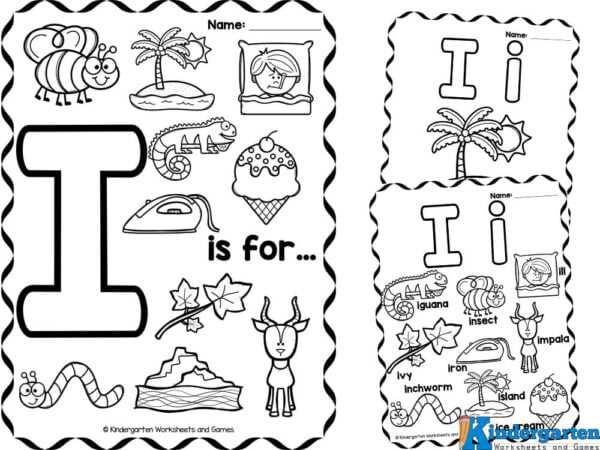
Choose alphabet worksheets featuring both uppercase I and lowercase i in bold 3–4 pt outlines and print them at 100% scale on A4 or US Letter paper to keep proportions accurate. Select designs with wide tracing guides and simple illustrations such as igloo, insect, and ice cream to reinforce phonics recognition.
Pick activity sheets with large character height, at least 10–12 cm tall, for preschool learners developing fine motor control. Clear directional arrows and dotted tracing lines help children practice stroke order while filling the shapes with crayons or colored pencils.
Use 90–100 gsm paper for everyday classroom practice and switch to 160 gsm cardstock for reusable alphabet crafts. Disable automatic scaling in printer settings and keep margins at least 0.25 inches to prevent cropped edges on tracing guides or border frames.
Letter I Coloring Pages Printable
Download alphabet sheets that feature both uppercase I and lowercase i with tracing guides and thick 3–5 mm outlines; print at actual size on A4 or US Letter paper to maintain correct proportions for handwriting practice.
Choose designs that pair the character with clear phonics visuals. Suitable image themes include:
- igloo with large empty sections for crayon fill
- insect with segmented body for detailed shading
- ice cream cone with patterned scoops
- island scene with palm tree and simple horizon line
Set printer margins to at least 0.25 inches and disable automatic scaling to avoid clipped tracing lines. For classroom sets, use 90–100 gsm paper; for craft-based activities such as cut-and-paste collages, switch to 160–200 gsm cardstock to prevent tearing.
Provide two difficulty levels: bold outline sheets for ages 3–4 and fine-detail illustrations with dotted stroke paths for ages 5–6. Character height should measure 10–12 cm for early learners and 6–8 cm for advanced tracing tasks.
Incorporate structured tasks directly on each worksheet:
- Trace uppercase form three times.
- Trace lowercase form three times.
- Color the related image.
- Circle objects that begin with the target sound.
Use grayscale vector files (300 DPI) to ensure clean edges and sharp print results. Avoid heavy background textures that consume ink and distract from letterform recognition.
For reusable practice, place finished sheets inside clear plastic sleeves and use dry-erase markers. This setup supports repeated tracing without reprinting multiple copies.
Store digital files in PDF format with one worksheet per file to simplify classroom distribution and prevent layout shifts across devices and printers.
How to Choose Uppercase and Lowercase I Worksheets for Early Learners
Select tracing sheets where the capital and small form are displayed side by side at a height of 8–12 cm, with clear baseline and midline guides. For preschoolers, choose bold outlines (3–4 mm stroke width) and dotted arrows that show stroke direction from top to bottom. Avoid decorative fonts; use simple sans-serif typefaces that match classroom handwriting standards.
Check that each activity page separates the tall vertical form from visually similar characters such as lowercase L and the numeral 1. Include comparison exercises where children circle the correct symbol among mixed options. Wide spacing between practice lines (at least 1.5 cm) reduces crowding and helps maintain straight alignment during pencil control drills.
Prioritize worksheets that combine tracing with phonics cues, such as small illustrations labeled with short vowel sounds. Three to five guided repetitions per form are sufficient for one session; more than that can lead to fatigue and uneven stroke quality. Choose PDF files at 300 DPI resolution to maintain sharp lines after printing.