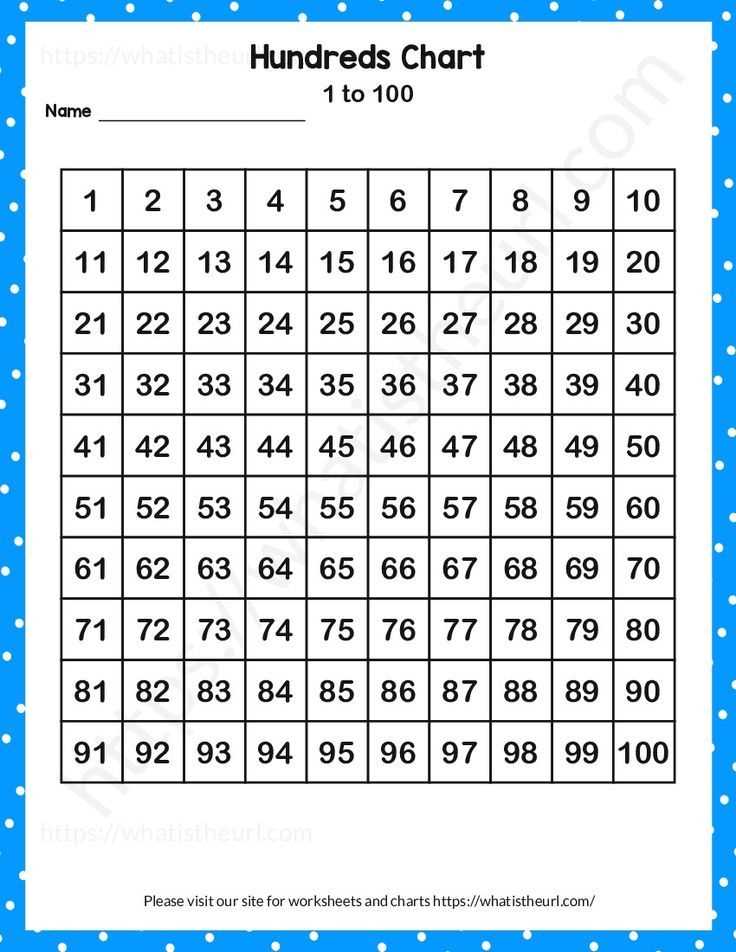
Using a numbered grid as a teaching tool provides immediate benefits for children and adults alike when learning arithmetic and number sequencing. One of the best ways to enhance numeracy skills is to create a visual map that helps students link numbers with their understanding of patterns and progressions.
How to Use a Number Grid for Learning
The grid presents numbers in a specific order, making it easier for learners to recognize relationships between figures. Whether you are practicing basic addition, subtraction, or multiplication, the grid makes it clear how numbers relate to one another in a linear format.
- Begin with small increments: Start by reviewing a range of ten numbers at a time to build confidence.
- Highlight number patterns: Focus on multiples (such as 2s, 5s, or 10s) for multiplication and skip-counting exercises.
- Practice mental math: Use the grid to quickly visualize arithmetic problems, making it easier to solve equations in your head.
How to Download and Print a Number Grid
Finding a template for your teaching needs is simple. Numerous free resources offer printable grids that you can either download or view online. Choose a grid that fits your requirements–some have larger numbers for younger students, while others cater to more advanced learners with higher-number grids. Ensure the format you choose is suitable for the age group and subject matter you’re working with.
Benefits of Regular Use of Number Grids
Consistent practice with a structured number sequence enhances a learner’s ability to quickly solve math problems. For younger children, visual aids like these can help them build a strong foundation, while adults can use them to refresh their skills or tackle more complex mathematical tasks. Some specific benefits include:
- Improved number recognition: Exposure to a wide range of numbers helps improve fluency and number literacy.
- Enhanced mental calculations: Students can visually see the effects of adding or subtracting numbers.
- Pattern identification: It’s easier to spot patterns, like odd/even number groupings or sequences.
Conclusion
A number grid serves as an excellent tool for anyone looking to improve their number-based skills. Whether for early learners, adults revisiting basic math, or as a visual aid for complex operations, a printable grid helps to create a more organized and accessible way to grasp the concepts. Download your grid today and begin practicing!
Creating a Visual Number Grid for Learning
For learners who are developing their number recognition and counting skills, a visual grid displaying numbers from 1 to 100 can be incredibly helpful. This layout provides a clear, organized way for children to track their progress in understanding numerical patterns and sequences. A simple printout of this grid can be used to enhance focus and assist with visual learning techniques.
Printouts like these are highly versatile and can be adapted for various activities. For example, they serve as an excellent tool for reinforcing concepts like skip counting, identifying even and odd numbers, or solving simple addition and subtraction problems. Kids can circle or color numbers they are working with, adding an interactive element to their practice sessions.
Having a copy of this grid at home or in a classroom can create an effective resource for quick reference. Teachers and parents can point to specific numbers on the chart during lessons, making it easier for students to visually connect with the material. This immediate visual reinforcement can increase memory retention of basic number concepts.
For those looking to customize the grid, there are many available templates online that allow you to modify the layout to fit particular educational needs. Some versions even include additional rows or columns for extended learning, such as counting by tens or labeling multiples.
Lastly, incorporating a number grid into daily routines can encourage young learners to practice numbers frequently, whether through games, quizzes, or simple exercises. Consistent exposure to such visual aids supports cognitive development in an engaging and memorable way.