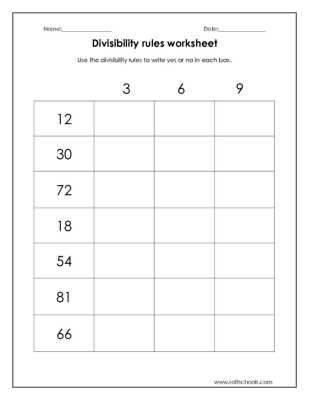
Start by familiarizing yourself with the conditions for divisibility by numbers like 2, 3, 5, 10, 6, 9, and 11. For example, a number is divisible by 2 if its last digit is even, such as 0, 2, 4, 6, or 8. Similarly, a number is divisible by 3 if the sum of its digits is divisible by 3. Having this knowledge on hand allows you to quickly assess divisibility without needing a calculator.
How to Use Divisibility Tests for Fast Calculations
These tests are useful for quickly simplifying fractions or determining if a number is divisible by a specific divisor. For instance, to check divisibility by 5, simply look at the last digit: if it’s 0 or 5, the number is divisible by 5. To check divisibility by 9, add the digits together, and if the sum is divisible by 9, the number is also divisible by 9. Similarly, a number divisible by 10 ends with a 0.
Having these conditions memorized can save time in various applications, such as simplifying fractions, solving problems in math exams, or when estimating possible factors. You can create a reference chart and place it somewhere visible for easy access during study sessions or practical use in real-world applications like budgeting or estimating quantities.
Creating a Divisibility Reference Chart
To make your own chart, list the divisibility tests for numbers 1 through 12. For example, for 6, the test is simple: check if the number is divisible by both 2 and 3. For 8, ensure that the last three digits form a number divisible by 8. This method allows you to quickly identify which divisors apply without having to rely on memorization for every single number.
Once you have your chart, print it on a sturdy piece of paper or laminate it to increase its durability. Keep it in your study area or carry it with you for quick reference. If you’re a teacher or tutor, you can create similar charts for students to help them learn and apply these techniques during math lessons or homework. Alternatively, the chart can be turned into a fun, interactive tool for kids to learn basic divisibility checks in a hands-on way.
How to Quickly Identify Divisibility for Basic Calculations
Start by checking if a number can be divided by 2. If the last digit is even (0, 2, 4, 6, 8), then the number is divisible by 2. For 5, just look at the last digit again; if it’s a 0 or 5, the number is divisible by 5. For 3, add all the digits together, and if the sum is divisible by 3, so is the number. These quick checks can help simplify your math problems without needing a calculator.
Creating a Quick Reference Chart for Divisibility Tests
To speed up the process, create a chart that lists these basic divisibility checks. Include divisibility for 2, 3, 5, 6, 9, and 10, along with their conditions. For example, for 6, the number must be divisible by both 2 and 3. For 9, the sum of the digits must be divisible by 9. Having this chart handy makes it easy to test a number without running through the steps each time in your head.
If you’re a student, keeping a reference chart next to your desk or notebook will save time during exams or homework. It’s a good practice to create your own version so you can personalize the layout and make it easy to read at a glance. If you’re teaching kids, this can be a fun way to engage them in learning simple math concepts. Let them color or decorate their charts to make learning more interactive.
Additionally, you can make the chart interactive by using it in games. Challenge others to find numbers that meet certain divisibility conditions, or use it to test larger numbers quickly. This is a great way to practice and ensure you know how to apply the conditions to various numbers efficiently.