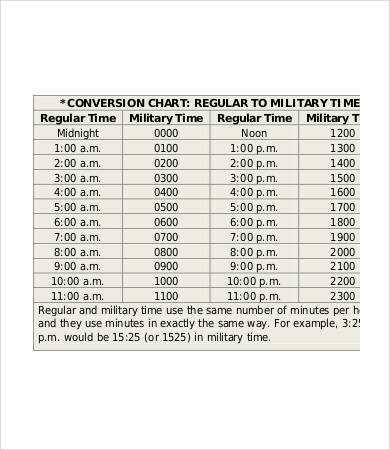
If you often need to convert civilian to military formats or vice versa, it’s helpful to have a reference tool on hand. Start by memorizing that the 24-hour format replaces the AM/PM distinction with numbers from 00 to 23. For example, 3:00 PM in standard time becomes 15:00 in the 24-hour system. To simplify conversions, focus on the rule that times after noon require adding 12 to the hour component, whereas morning times remain unchanged.
Another useful tip is to understand the difference between a time like 01:30 and 0130. The civilian notation requires a colon between the hour and minute, while the military version eliminates it. This small adjustment can help when reading or writing time on military documents, schedules, or digital displays that follow this strict format.
To make the process even easier, you can create or download a table with examples of both systems side by side. This allows you to quickly find the equivalent for any given point in the day. Such resources are particularly valuable for anyone working in fields where accurate timekeeping is crucial, like aviation, the military, or international logistics.
Military Standard Time Conversion Guide
To easily read 24-hour notation, start by remembering that any time from 1:00 AM to 11:59 AM remains unchanged in the 24-hour system. The difference comes with times from 12:00 PM onward. Simply add 12 to the number for PM times. For instance, 2:00 PM becomes 14:00.
Using the 24-hour format is particularly helpful in areas like the military, healthcare, or any profession where precision is critical. For example, 8:00 AM stays as 0800, but 8:00 PM turns into 2000. This eliminates any confusion between AM and PM.
If you need to convert from a 24-hour number back to the standard 12-hour format, subtract 12 from any value higher than 1200. So, 1500 becomes 3:00 PM, and 2200 becomes 10:00 PM.
For clarity, always include the leading zero in times less than 10. For example, 7:00 AM would appear as 0700 to avoid any ambiguity.
When creating a conversion reference, align all times in ascending order for easy cross-checking. Group times in blocks, such as 0000-0100, 0100-0200, etc., which will speed up reading and reduce errors.
Creating a simple reference guide where you list both formats side by side can save you time. Listing the 12-hour format in one column and the corresponding 24-hour format in another ensures no mix-ups.
Having a reference chart can also be beneficial for those new to reading military-style time or for use in educational environments. By regularly practicing conversions, anyone can become proficient at switching between formats in a matter of minutes.