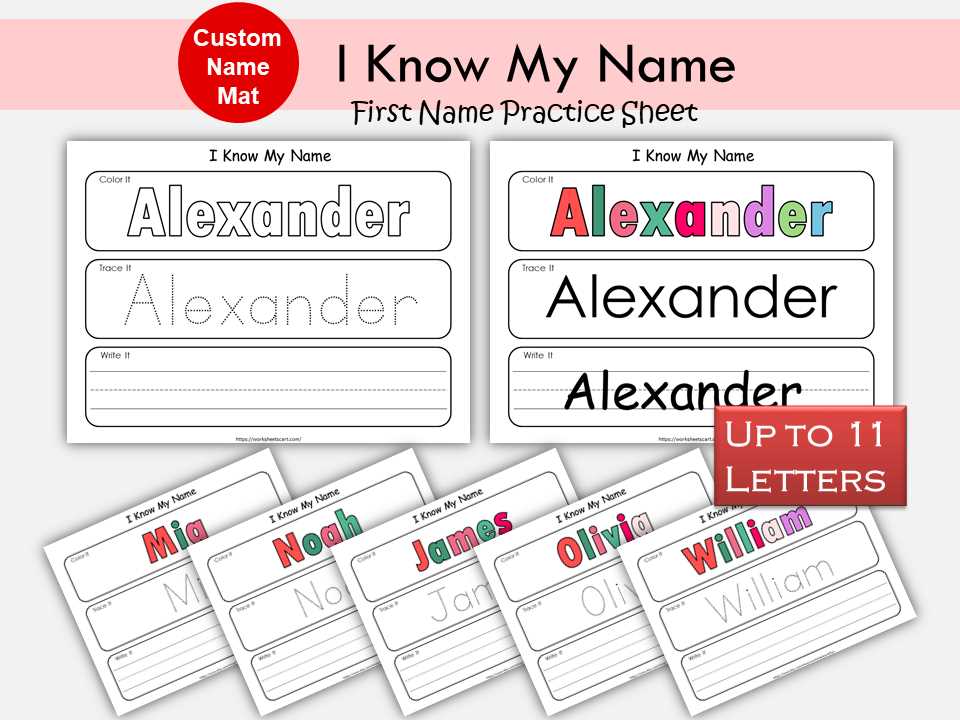
For effective learning, provide children with sheets that allow them to practice writing their personal details, adapting each template to their unique preferences. These resources are an excellent way to help young learners strengthen motor skills while connecting their handwriting to something meaningful. By offering a tailored approach, you can keep their interest high, ensuring that practice feels less like a task and more like a fun activity.
Start with clear, bold lines that guide each stroke, helping children form letters with confidence. These exercises are especially useful for beginners, offering them the chance to improve both legibility and speed. Adjust the size of the characters and spacing to match the child’s developmental stage, progressively increasing difficulty to keep them engaged without overwhelming them.
Additionally, varying the design of each worksheet–such as incorporating colorful accents or simple illustrations–can enhance the learning experience. Personalizing the text further with the child’s favorite themes or characters provides a sense of ownership, turning every session into a fun and interactive session that reinforces skills while keeping things exciting.
HTML
Improving Handwriting with Personalized Letter Practice Sheets
One of the most effective ways to help children improve their handwriting is by providing them with worksheets tailored to their individual needs. By focusing on specific letters or combinations of letters, you can ensure targeted practice. Worksheets where learners repeatedly write their own name or any word they are familiar with can significantly boost motor skills and letter recognition.
These writing exercises can be easily customized for different age groups. For younger children, tracing lines and basic shapes in combination with simple words can build confidence. Older children can benefit from more complex exercises involving longer names or multiple words. Gradually increasing the complexity of the activities ensures steady progress without overwhelming the learner.
In addition, personalized writing sheets can be adapted to suit various fonts or handwriting styles. Opting for more playful or cursive fonts can spark interest in students, making the practice feel less like a task. Teachers or parents can also add helpful prompts, such as arrows or dotted lines, to guide the hand motion.
- Choose appropriate font styles for different learning levels.
- Make sure the letters are spaced correctly to encourage proper formation.
- Include short, meaningful words to enhance motivation.
How to Create Sheets for Preschoolers to Practice Writing Their Names
Begin with selecting a simple, readable font. Avoid overly decorative styles that may confuse young learners. Choose one that clearly shows the individual letters without excessive flourishes. For better clarity, use a font where each letter is easy to distinguish and doesn’t blend with others.
Next, structure the sheet with three distinct lines. The first line should have the name in bold, dark print, large enough for the child to trace over. The second line should be a dotted or dashed version of the name, making it easy to follow. Lastly, provide a blank line underneath where the child can write the name independently after practicing.
To make the activity engaging, incorporate a picture of something related to the name. For example, if the child’s name is “Emma,” you might add a small picture of an elephant, which begins with the same letter. This visual association helps reinforce letter recognition and makes the practice more interactive.
Ensure the letters have consistent spacing and enough room for the child to properly form each one. The size of the letters should be large, as preschoolers are still developing fine motor skills. By keeping the spaces wide, they can practice proper writing techniques without feeling cramped or rushed.
For added variety, consider varying the lines. For example, use solid lines for some letters and dotted lines for others to maintain interest. You can also experiment with colors to help differentiate between the tracing part and the free-writing part, offering a fun visual cue to help them stay focused.
Lastly, ensure there’s a way for the child to track progress. A simple checklist or star system can help them feel a sense of accomplishment after each session. This not only motivates them but also allows for incremental improvement, building their confidence as they continue to practice.