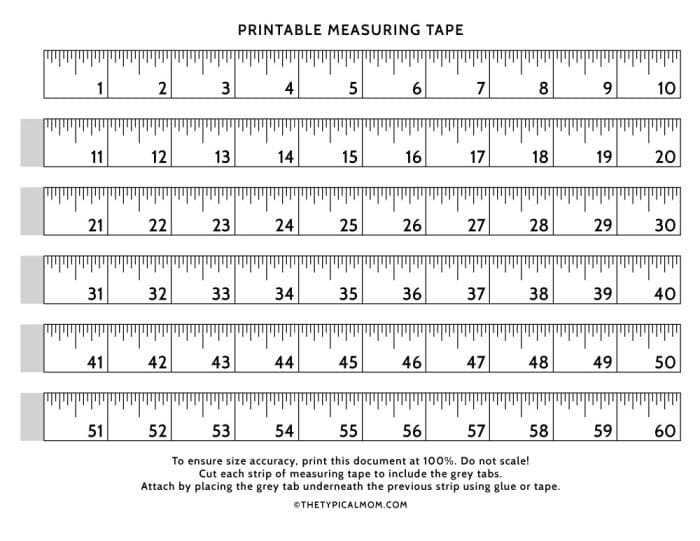
If you struggle with understanding the units on a ruler or measuring tool, using a guide for quick reference can simplify the process. Start by understanding the most common markings, like fractions of an inch and millimeters. These references help you get precise measurements without guesswork.
Focus on recognizing the smallest divisions on your device. For instance, an inch is usually divided into 16 segments, and each segment represents a fraction. Knowing what each fraction means in real terms, such as how 1/8” compares to 1/16”, helps you achieve accuracy. Marking these values clearly on a guide allows you to make faster decisions when measuring objects or materials.
To get the best results, use a hands-on approach. Practice measuring everyday items, such as books or pieces of furniture, with your guide. Over time, you’ll build confidence in interpreting measurements quickly, which will make tasks like home improvement or craftwork much more efficient.
Printable Guide for Understanding Measurement Units
Start by familiarizing yourself with the main divisions of a standard ruler. Every inch is divided into smaller sections. The most common divisions are 1/2, 1/4, 1/8, 1/16, and sometimes even 1/32 inch. A good reference guide will clearly mark these divisions, helping you quickly convert fractions into decimal values if needed.
Another useful feature is the ability to easily identify 1/8” increments, which are typically marked with longer lines. Keep track of these when you need precision for tasks like carpentry or crafting. The markings for 1/16” are shorter, so be sure to focus on them for measurements that require more accuracy.
Use color coding to separate different measurements on your guide. For instance, you could use red for larger increments, like 1 inch and 1/2 inch, while green or blue could represent the smaller fractions such as 1/8” or 1/16”. This simple visual system will help you quickly identify the correct unit without confusion.
Make sure to practice by measuring a few items around your workspace. Measure things like a book or a piece of wood to verify that you are accurately interpreting the scale. The more you practice, the easier it will become to recognize fractions at a glance.
Finally, store your reference guide in a place that’s easy to access when working with measurements. Whether you place it near your workstation or keep it in a tool kit, having it available will save you time and reduce errors while measuring items.
Understanding the Basics of a Measurement Tool and Its Scale
Begin by identifying the primary components of a measurement tool. The tool typically includes markings for inches and fractions of inches. Each inch is divided into smaller sections, usually 1/2, 1/4, 1/8, and 1/16, allowing for various degrees of precision. Familiarizing yourself with these divisions is crucial for accurate measurements.
Inches are the largest division on the scale, often marked with longer lines. Every inch is subdivided into smaller fractions, each representing a portion of an inch. The most common fraction is 1/2 inch, and these markings are typically the longest of the smaller divisions. The 1/4-inch divisions are marked slightly shorter, while 1/8-inch markings are even smaller.
Understanding how to read the smaller increments is important for precise measurements. For example, a line halfway between two 1/2-inch divisions represents 1/4 inch. Lines placed halfway between each 1/4 inch are used to represent 1/8 inches. This system ensures that you can measure in smaller, more accurate units.
Smaller subdivisions, such as 1/16 and 1/32 inches, are often represented by even finer lines. These are typically used when high precision is necessary, such as in woodworking or metalworking. These tiny divisions are harder to distinguish, so practice is key to interpreting them quickly and accurately.
Most measurement tools will also have a decimal scale alongside the standard fractional markings. This scale is helpful when you need to convert fractions into decimal form. For instance, 1/8 inch equals 0.125 inches, and 1/4 inch equals 0.25 inches. Having both systems on the same tool allows for flexibility in measurements.
Remember that the numbers marked on the scale are not always placed at the exact center of each section. They are often offset slightly, and the lines between the numbers indicate smaller divisions. This offset helps to differentiate between the larger and smaller increments, but it may take some time to get used to reading these non-aligned markings.
Finally, practice measuring objects to build familiarity. Measure simple items first, such as a pencil or a book, and then move to more complex shapes. Over time, reading a measurement tool with precision will become second nature, making it easier to get exact measurements for a variety of tasks.