Download a high-resolution 9×9 strategy grid in PDF format and print it at 100% scale on A4 or US Letter paper for clear alignment of all mini-boards. Choose a layout with bold outer borders (at least 2 pt line weight) and lighter inner lines (0.5–1 pt) so players can easily distinguish between the nine local 3×3 sections and the main grid.
This expanded noughts-and-crosses variant uses nine small boards arranged in a larger square. Each move determines the next local board your opponent must play in, which increases planning depth and reduces random play. A clean black-and-white layout saves ink, while adding subtle shading to completed sections helps track progress during longer matches.
For classroom or tournament use, prepare multiple sheets and laminate them for reuse with dry-erase markers. Leave a 1–1.5 cm margin around the grid to prevent trimming issues and ensure consistent scaling. A well-formatted PDF file should be under 1 MB for quick sharing and maintain sharp vector lines for repeated printing without loss of clarity.
Ultimate Tic Tac Toe Printable
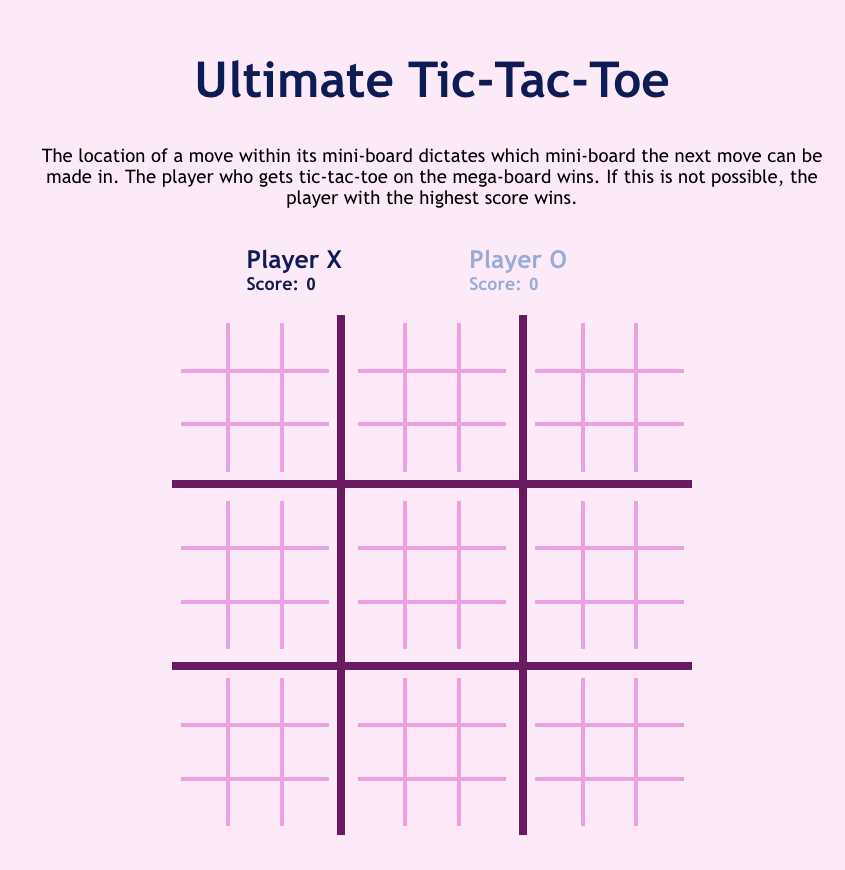
Use a 9×9 grid composed of nine 3×3 boards arranged in a larger square and export it as a vector PDF with 300 DPI resolution for sharp lines on any home printer. Set outer borders to 2 pt and inner cell lines to 0.75 pt to keep the macro and micro boards visually distinct. Leave space beneath the grid for recording match results and player names, and include a small rule reminder stating that each move sends the opponent to the corresponding mini-board.
For repeated play, print the strategy sheet on 120–160 gsm paper to prevent ink bleed and laminate it for use with dry-erase markers. If organizing group sessions, prepare at least 10 copies to avoid downtime, and mark completed local boards with diagonal shading so players can track claimed sections without confusion during longer matches.