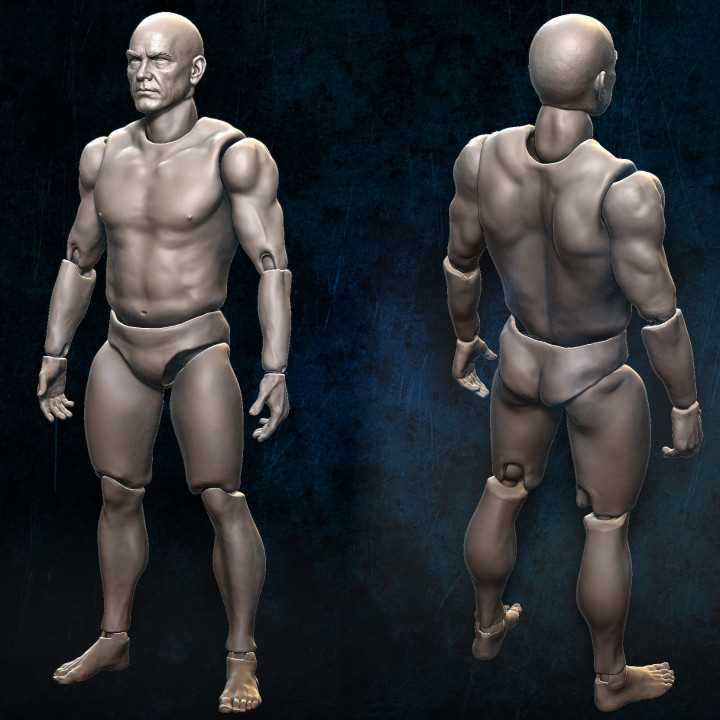
If you’re working on a design or sculpting project and need a realistic, scaled version of the human form, start by selecting a high-quality digital model. You can find a variety of options online, from free resources to premium libraries, that provide detailed models of the body in different poses and anatomical structures.
When choosing a model, consider its level of detail and how closely it aligns with your project needs. For example, models with more intricate details, like muscles or facial features, can be used for medical or educational purposes, while simpler shapes may be more suitable for artistic designs or prototypes.
Once you’ve found a suitable file, ensure it’s compatible with your 3D software and printer. Popular design programs such as Blender, Tinkercad, and ZBrush allow you to modify or refine these models before printing, enabling you to adjust the size, proportions, or even combine different poses for a unique final result.
Using a quality material such as PLA or ABS for 3D printing will yield better results in terms of durability and accuracy, especially when creating detailed sculptures or prototypes that require fine textures and intricate features.
Finally, always test the model with smaller prints before committing to a large-scale production. This ensures that the proportions, details, and printer settings are optimal for your final output.
3D Models of the Body for Various Uses
For educational purposes, 3D representations of the body are highly useful. They offer a detailed and accurate depiction of anatomy, allowing students and professionals in fields like medicine and biology to examine the structure of the body from every angle. These models can be printed in various sizes, making them suitable for hands-on learning in classrooms or for use in medical training.
In art and design, 3D bodies serve as reference models for sculptors and digital artists. These virtual representations help artists understand proportion, anatomy, and the human figure in different poses. By adjusting these models, artists can experiment with different compositions before committing to a physical sculpture, speeding up the creative process.
For gaming and film industries, 3D body models are essential for creating realistic characters. Animators rely on these digital creations to craft lifelike movements and expressions. The high level of detail and customization options make it possible to design characters that fit specific styles or requirements for different media projects.
3D-printed prototypes of the human form are also widely used in fashion and product design. Designers can create accurate wearable items or accessories by printing body models and testing their designs directly on them. This allows for a more efficient and precise fit and finish before the final product is made.
Choosing the Right 3D Model for Your Project
When selecting a 3D model for a specific project, first consider the level of detail required. For educational or scientific purposes, opt for models that offer intricate features and accurate proportions. Detailed designs allow for a more comprehensive study of anatomy or mechanical structures, making them suitable for research or teaching tools.
If the model is intended for artistic purposes, such as digital sculpture or animation, flexibility and ease of modification become key factors. Look for models that allow for smooth adjustments to shape, texture, or pose. This will enable you to refine and personalize the creation during the design process without complications.
Consider the size and scale of the model. For smaller, more compact designs, simplicity and lower polygon count may be more effective to avoid unnecessary complexity. Larger models, however, may require high resolution and more detailed work to achieve the desired outcome, especially if physical prototypes are part of the plan.
Check compatibility with your design software and 3D printing setup. Different platforms support various file formats and settings. Ensure the model can be easily imported and processed by the software you intend to use, and that it fits within the specifications of the printer or equipment you have at hand.
Finally, always consider the purpose of the model. If it’s for display, aesthetic appeal will be a priority, while for functional use, accuracy and durability may take precedence. For prototyping or simulation, opt for models with robust geometries to withstand testing and real-world applications.