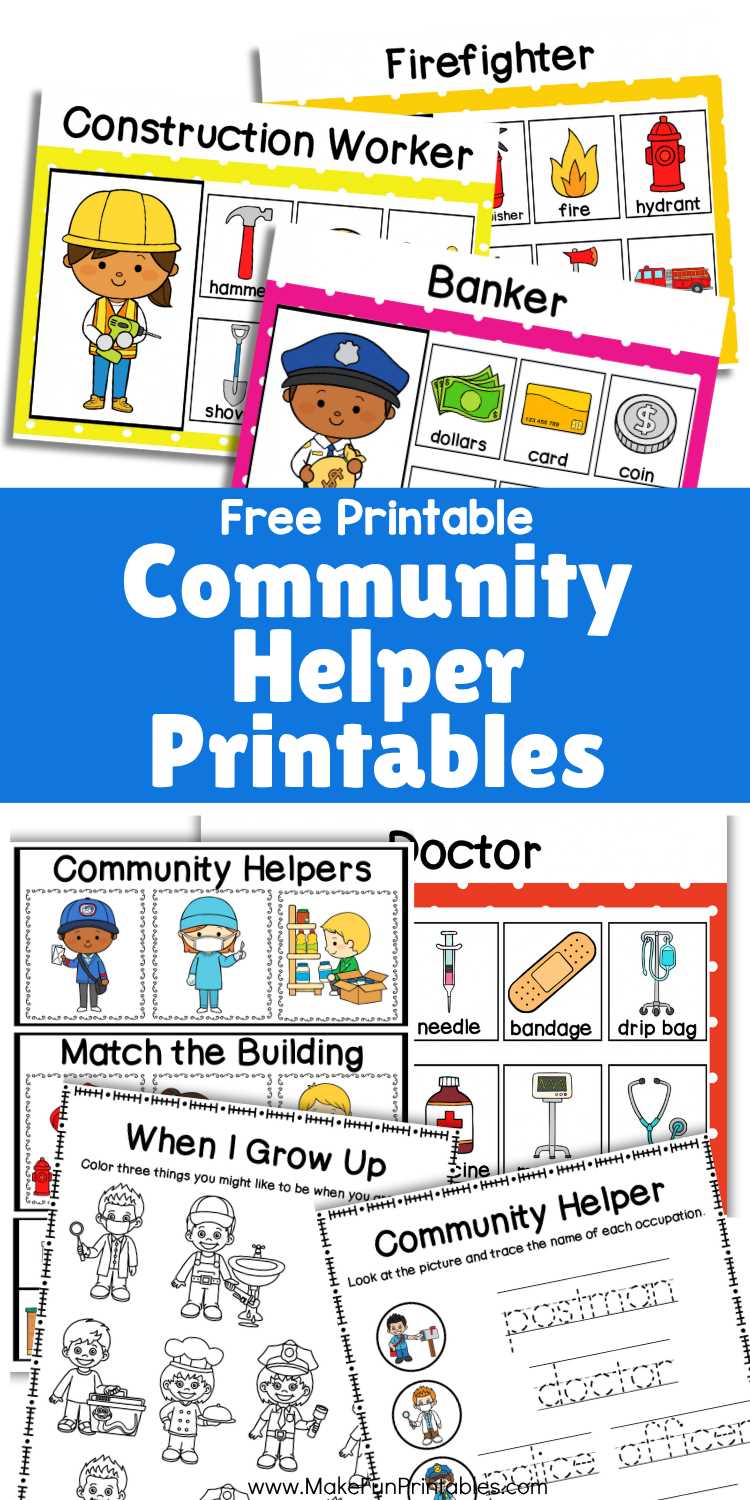
Choose activity pages that match the child’s reading level and fine motor skills, then print them at 100% scale to keep tracing lines and picture proportions accurate.
Selecting Role Based Learning Pages by Age
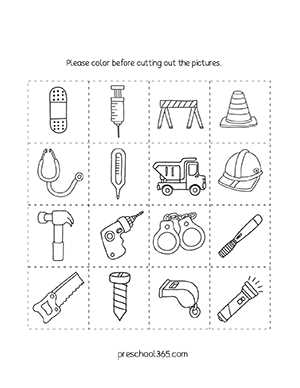
For preschool (ages 3–4), use coloring sheets with large outlines of occupations such as firefighter, doctor, police officer, and mail carrier. Lines should be at least 2–3 mm thick to support early hand control. Add simple matching tasks where children connect a worker to tools like a hose, stethoscope, badge, or delivery bag.
For kindergarten (ages 5–6), include short reading prompts with 3–5 word sentences such as “The nurse helps patients.” Provide dotted word tracing with 12–14 pt font and clear baseline guides. Limit each page to one main task to maintain focus.
Using Occupation Themed Activity Sheets for Skill Practice
Reading and Vocabulary
Create word-to-picture matching lists with 6–8 terms per page. Use simple nouns and verbs related to public service roles. Add a small checkbox near each word to support visual tracking.
Writing and Fine Motor Development
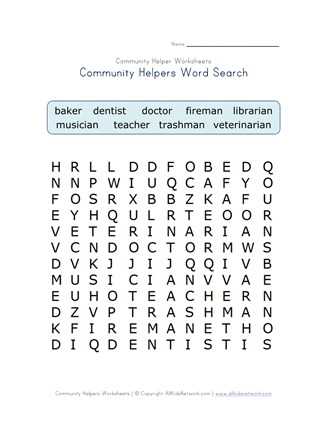
- Trace job titles in uppercase and lowercase letters
- Copy short sentences onto ruled lines
- Circle correct tools linked to each profession
Sorting and Critical Thinking
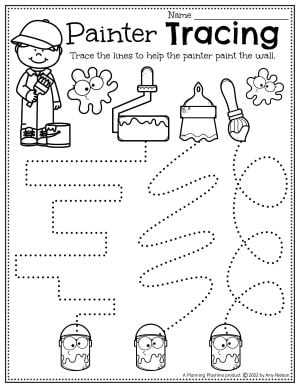
- Group occupations by workplace such as hospital, school, fire station
- Identify which tools belong to each role
- Compare uniforms and discuss safety equipment
Store printed pages in labeled folders by skill area to reuse them for review sessions and small group activities. Rotate themes weekly to reinforce recognition without repeating identical layouts.
Community Helpers Printable Worksheets
Select occupation-themed activity sheets that match the child’s age, then print at actual size so tracing lines and picture details remain clear and proportional.
For ages 3–4, use coloring pages with bold outlines of roles such as firefighter, nurse, police officer, teacher, and construction worker. Line thickness should be no less than 2 mm to guide crayon control. Add simple matching tasks where children draw a line between a worker and three related tools. Limit each page to one instruction sentence under 8 words.
For ages 5–6, include short reading passages of 20–30 words followed by two comprehension questions. Provide dotted-letter tracing for job titles in both uppercase and lowercase. Use primary writing lines with a midline to guide letter height.
Incorporate sorting exercises where learners categorize professions by workplace such as hospital, school, fire station, or construction site. Offer cut-and-paste tasks using safe scissors with rounded tips and glue sticks to improve coordination.
Add counting activities connected to each role, for example counting five traffic cones or six medical kits. Combine numeracy with visual recognition to reinforce multiple skills on a single page without overcrowding the layout.
Store completed pages in labeled binders organized by reading, writing, math, and fine motor practice so progress can be tracked and reviewed during weekly skill checks.