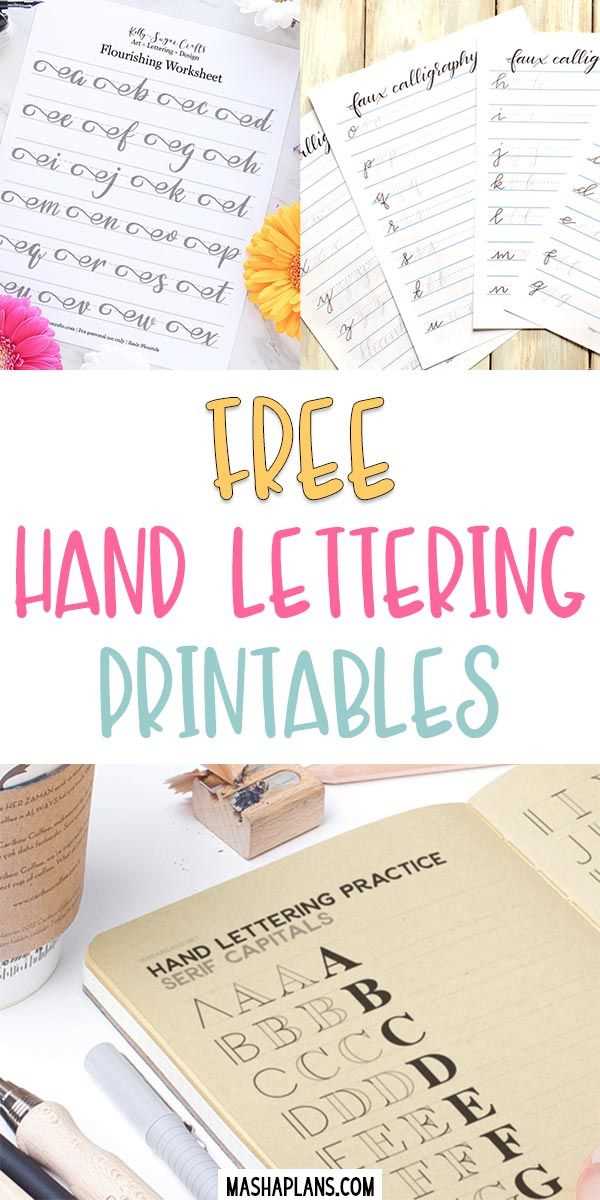
Download high resolution PDF practice sheets at 300 DPI and print them on 120 gsm smooth paper to achieve clean stroke control with brush pens or fineliners.
Choose drill sets that isolate basic strokes such as upstrokes, downstrokes, ovals, and connector lines before moving to full alphabet forms. Limit each session to 15–20 minutes and repeat one stroke pattern across an entire page to build muscle memory. Use guidelines with a 55–60 degree slant line grid when practicing script styles.
Track pen pressure consistency by comparing thin upstrokes and thick downstrokes under bright light. Maintain even spacing between letters by following baseline and x height guides printed on each sheet. Progress to word combinations only after individual characters maintain consistent proportions.
Print multiple copies of the same drill and date each attempt. Compare line smoothness, curve balance, and stroke transitions weekly to measure improvement in control and rhythm.
Free Printable Lettering Worksheets
Download high resolution calligraphy drill sheets in PDF format at 300 DPI and print them on smooth 100–120 gsm paper to maintain sharp stroke edges and prevent ink feathering.
Focus on structured practice pages that separate skill components into clear sections:
- Basic stroke repetition lines with entry and exit guides
- Lowercase alphabet grids with x height markers
- Uppercase forms with proportion references
- Word tracing lines with 55 degree slant guides
Limit each session to one skill category and fill an entire sheet with consistent pen pressure. Use brush pens with flexible nibs for thick downstrokes and thin upstrokes, or fineliners sized 0.3–0.5 mm for monoline script drills.
Adjust printer settings to highest quality output and disable scaling. Keep margin alignment intact so baseline and ascender lines remain accurate. Run a single test copy before printing multiple sets.
Review completed practice sheets weekly using measurable criteria:
- Uniform stroke thickness
- Consistent letter height ratio
- Even spacing between characters
- Smooth curve transitions without visible hesitation marks
How to Practice Basic Strokes and Letterforms Step by Step
Begin with isolated stroke drills and repeat each motion across a full guideline sheet before attempting complete characters.
Practice thin upstrokes by applying light pressure while moving the pen upward at a 55 degree angle. Maintain consistent speed and keep lines parallel using slant guides. Fill at least three rows with identical strokes to build muscle memory.
Switch to thick downstrokes by increasing pressure on the downward movement. Keep the nib steady and avoid twisting your wrist. Compare stroke width under direct light to check uniform thickness.
Combine upstrokes and downstrokes to form compound shapes such as ovals and loops. Focus on smooth transitions at connection points without visible breaks. Pause briefly at the baseline to reset hand position if control weakens.
Move to basic letter structures built from repeated components. For example, practice “i” and “l” before attempting “h” and “k,” since they share vertical stems. Group similar forms together rather than following alphabetical order.
Limit sessions to 20 minutes to prevent hand fatigue. Overtraining reduces line precision and increases shaky curves.
Use tracing sheets first, then shift to blank guideline templates. Reduce reliance on tracing once proportions remain consistent across three consecutive attempts.
Review each sheet and mark inconsistencies in height ratio, spacing, and stroke contrast. Date every practice set and compare weekly samples to measure improvement in control and alignment.