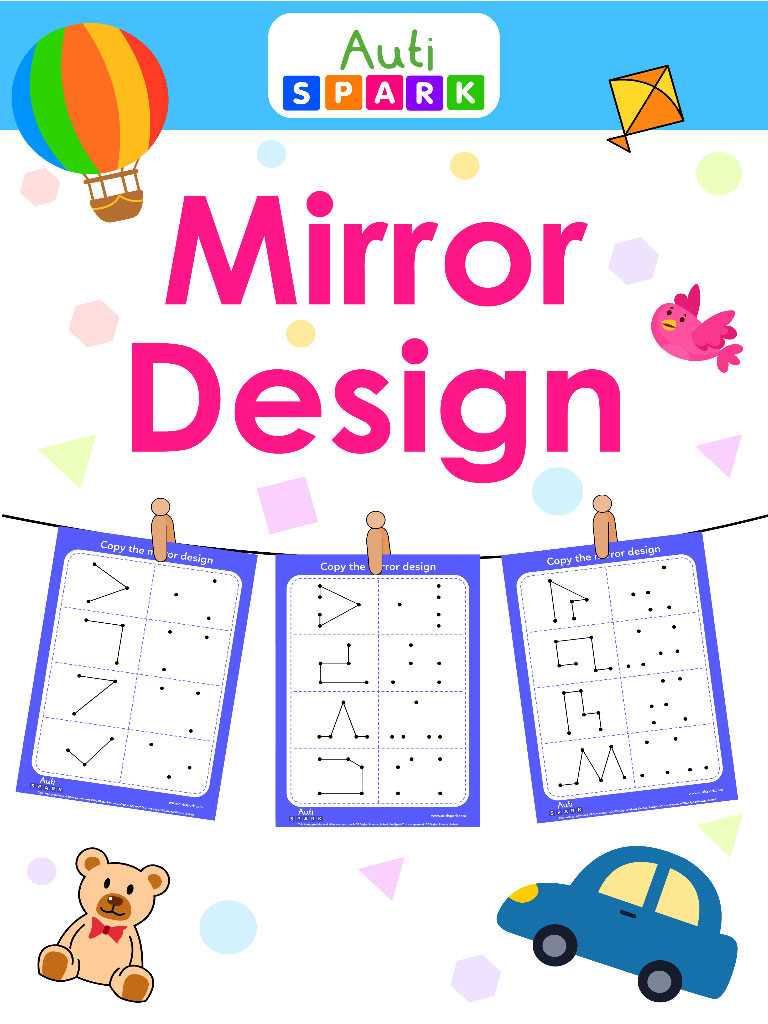
Use reflection drawing sheets with a clear center line and bold outlines to help children grasp left-right relationships quickly. For ages 4–6, choose tasks with 4–8 missing details; for ages 7–9, increase to 10–18 elements. Files saved at 300 DPI produce crisp lines on standard A4 paper and reduce eye strain during tracing.
Place the sheet inside a transparent sleeve or laminate it before giving it to a child. This allows repeated practice with dry-erase markers and prevents paper wear after just a few sessions. Set line thickness to at least 1.2–1.5 pt when preparing the worksheet; thinner strokes often break during home printing and confuse young learners.
Limit each activity to one central axis and avoid crowded scenes. Children complete tasks faster when the blank side occupies no more than 40–50% of the page. Black-and-white layouts with high contrast work better than pale gray sketches, especially for early learners who are still developing visual discrimination skills.
Schedule short sessions of 5–8 minutes and ask the child to trace first, then copy freehand. This two-step approach improves spatial accuracy and hand control. Track progress by timing how long it takes to complete one sheet and by counting symmetry errors; a steady drop in mistakes over 2–3 weeks signals strong visual processing growth.
Mirror Image Printable Worksheets and Symmetry Activities for Kids Practice
Choose symmetry worksheets with a bold center guideline and minimal background detail to help children copy shapes accurately. For beginners aged 4–5, select pages where no more than six elements must be completed; older children can handle layouts with 12–20 missing parts. Keep line weight above 1.2 pt so contours remain clear after home printing.
Use standard A4 paper and set printer scaling to 100% to avoid distortion of proportions. When the page shrinks automatically, children often misjudge distances from the central axis. A resolution of 300 DPI keeps edges sharp and prevents pixelated outlines during close visual work.
Introduce tracing first, then switch to freehand copying during the same session. This two-phase method builds hand control and spatial awareness faster than copying alone. Limit one exercise block to 6–10 minutes; longer periods tend to reduce attention and increase random mistakes.
Keep visual clutter low by selecting worksheets with one clear object per page. Busy scenes slow recognition and make young learners guess rather than observe. The unfinished side should cover roughly half the sheet so the task remains balanced and readable.
Laminate frequently used pages or place them in plastic sleeves. Children can practice with dry-erase markers, wipe the surface clean, and repeat the activity multiple times. This approach cuts printing costs and allows quick daily drills without preparing new materials.
Track progress using two simple metrics: time to finish and number of symmetry errors. If a child completes a page in under three minutes with fewer than three mistakes, move to a more detailed design. Gradual difficulty increases maintain steady skill growth.
Rotate themes weekly–animals, vehicles, simple geometric forms–to maintain interest without changing the task structure. Consistent layout paired with varied subjects keeps practice predictable while still engaging young learners.
How to Choose Age Appropriate Mirror Image Worksheets for Children
Select worksheets based on the child’s fine motor control rather than grade level. For ages 4–5, choose pages with thick outlines (at least 1.5 pt) and no more than four missing elements across the central line. Older children can manage thinner contours and more complex shapes.
Check the distance between the center axis and the drawing. Younger learners perform better when the gap does not exceed 3–4 cm, which reduces visual estimation errors. For ages 7+, wider spacing of 5–7 cm adds a healthy challenge without causing frustration.
Evaluate object complexity before downloading. Simple geometric forms and basic animals suit beginners, while layered scenes with overlapping parts fit children who already copy shapes accurately. Avoid pages where multiple small details cluster near the fold line.
Match session length to age. Preschoolers work productively for about 5 minutes per sheet, while children aged 8–10 can handle 10–15 minutes of focused copying. If mistakes increase sharply near the end, the material is too demanding.
Review visual contrast on the page. Black lines on a clean white background reduce eye strain and help children judge proportions correctly. Faded gray outlines or decorative backgrounds often lead to uneven results.
Update difficulty gradually every two to three weeks. Move from half-drawn figures to partial grids, then to freehand symmetry tasks. This steady progression builds spatial accuracy without overwhelming the learner.