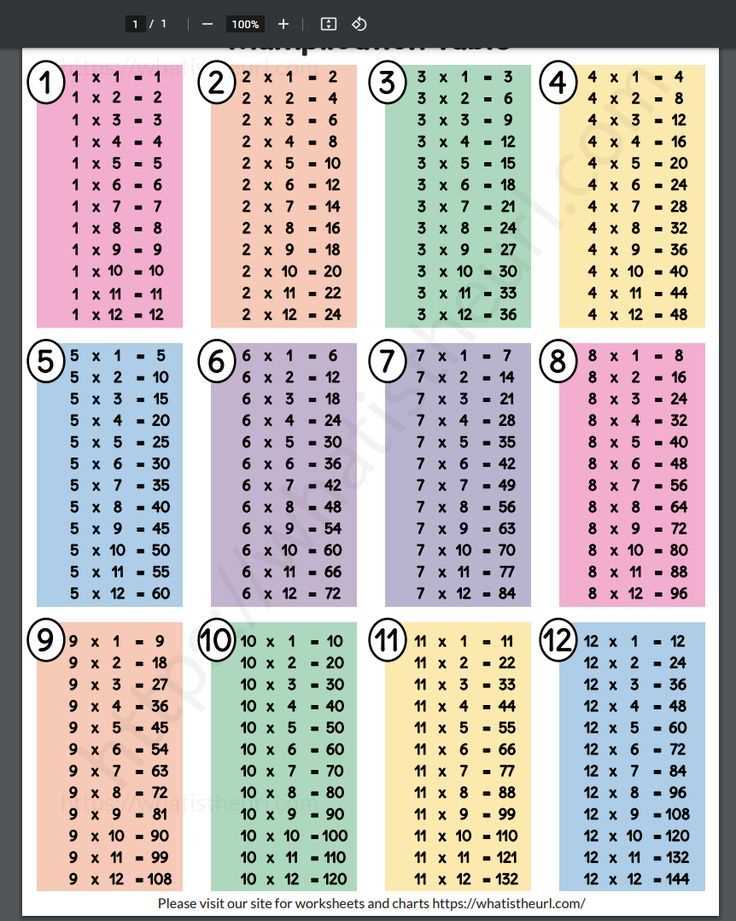
Practice number facts from 2×2 through 12×12 in short daily sessions of 10–15 minutes using structured drill sheets that group problems by factor. Begin with single-factor sets such as the 3s or 4s, aiming for at least 90% accuracy before mixing operations across multiple factors.
Use timed exercises of 30–60 seconds per row to build recall speed while maintaining accuracy above 85%. Track progress weekly by recording total correct answers out of 100 problems; steady growth of 5–10 additional correct responses per week indicates improving retention.
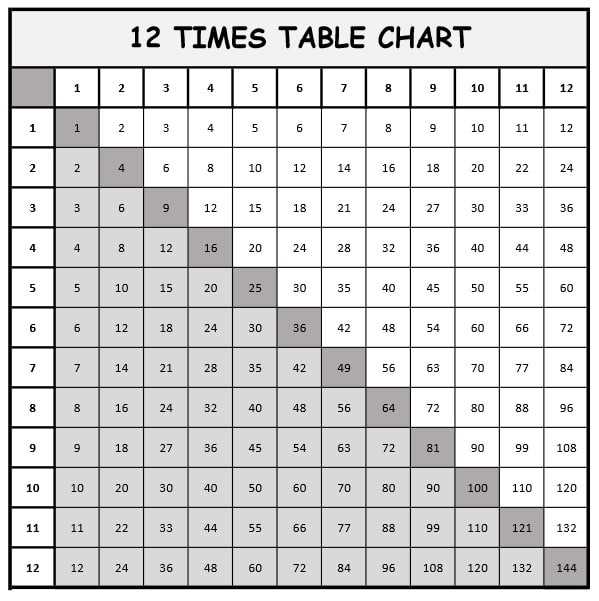
Alternate between horizontal problem lists and grid charts that display full fact matrices from 1 through 12. Grids support pattern recognition, while linear drills strengthen rapid response. Include answer keys on a separate page to allow independent checking and immediate error correction.
Print on standard A4 or US Letter at 100% scale to preserve alignment of columns and spacing between problems. Clear 12–14 pt fonts and at least 1 cm of writing space per answer reduce visual clutter and support neat calculation.
Multiplication Tables 1-12 Printable Worksheets
Use structured fact grids covering products from 2×2 through 12×12 and assign one factor family per day, completing 40–60 problems in under 15 minutes. Move to mixed sets only after the learner reaches at least 90% accuracy on single-factor drills across two consecutive sessions.
Alternate between vertical problem columns and full 10×10 or 12×12 number charts to strengthen both recall speed and pattern recognition. Charts highlight relationships such as square numbers and commutative pairs, while linear exercises push faster response under light time pressure.
Introduce timed quizzes of 100 problems with a 5-minute limit to measure fluency growth. Record weekly scores and track both total correct answers and average completion time; steady improvement should show rising accuracy alongside reduced hesitation per item.
Print at full scale on standard A4 or US Letter with clear spacing of at least 1 cm per answer line and font size between 12–14 pt. Provide a separate answer key for self-checking and require error correction by rewriting missed facts three times to reinforce retention.
How to Structure Daily Practice Using Tables 1 to 12
Allocate a fixed 12-minute session each day focused on one factor group, keeping the total number of problems between 50 and 70. Short, consistent practice blocks improve recall more reliably than a single long session once a week.
Divide the session into three segments:
- 3 minutes of oral recall with rapid questions
- 6 minutes of written drills on a single factor set
- 3 minutes reviewing incorrect answers
Rotate factor groups systematically across the week, ensuring that each set from 2 through 12 appears at least twice in a 14-day cycle. Revisit any group scoring below 85% accuracy before introducing additional mixed exercises.
Introduce mixed problem sheets only after single-factor accuracy remains above 90% for three consecutive sessions. Limit mixed sets to 40 questions at first, gradually increasing to 100 as response speed improves.
Use a simple tracking chart with columns for date, factor group, total correct answers, and time taken. A visible record encourages steady improvement and highlights patterns of difficulty, such as slower recall for 7s or 8s.
Incorporate cumulative review every Friday with a timed 5-minute test covering products from 2 to 12. Compare results week to week and adjust the next schedule based on error frequency.
End each session with verbal repetition of five previously missed equations, stating the full number sentence aloud to reinforce memory through both written and spoken practice.