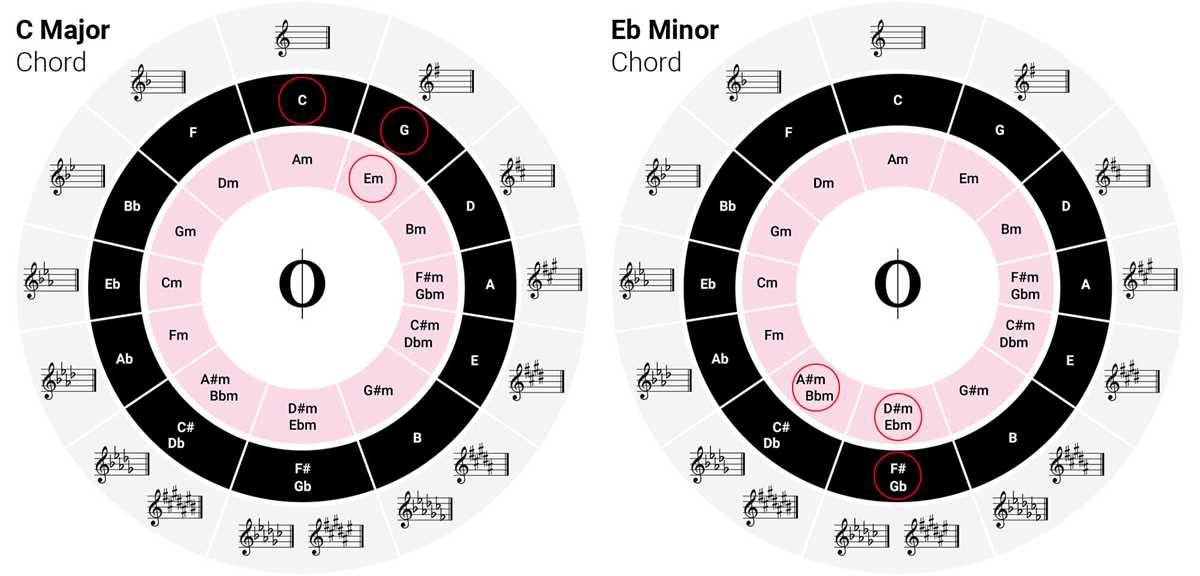
One of the best ways to quickly grasp music theory is by understanding the relationships between key signatures. A simple chart that displays the order of sharps and flats across various keys can make learning these relationships easier. Start by focusing on the most common musical keys, such as C major, G major, and F major, and use the visual diagram as a reference while practicing.
Identifying Sharps and Flats in Different Keys
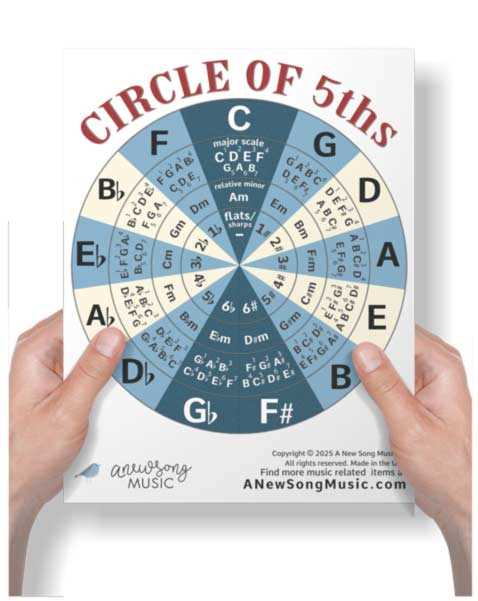
In a typical key reference chart, you will notice how each key signature changes as you move around the wheel. The first thing to remember is that keys with sharps are always to the right, while keys with flats are to the left. This clockwise and counterclockwise progression allows you to easily identify the number of sharps or flats in each key. For example, G major will have one sharp, while D major will have two. On the other hand, keys like F major will have one flat, and B-flat major will have two flats.
Understanding Major and Minor Key Relationships
The diagram also helps you visualize the connection between major and minor keys. Each major key shares a relative minor key that is located a minor third below the root of the major key. For example, A minor is the relative minor of C major. By studying the chart, you can quickly see how these keys relate to one another, making it easier to understand modulation and transposition in your practice.
Creating a Custom Diagram for Personal Use
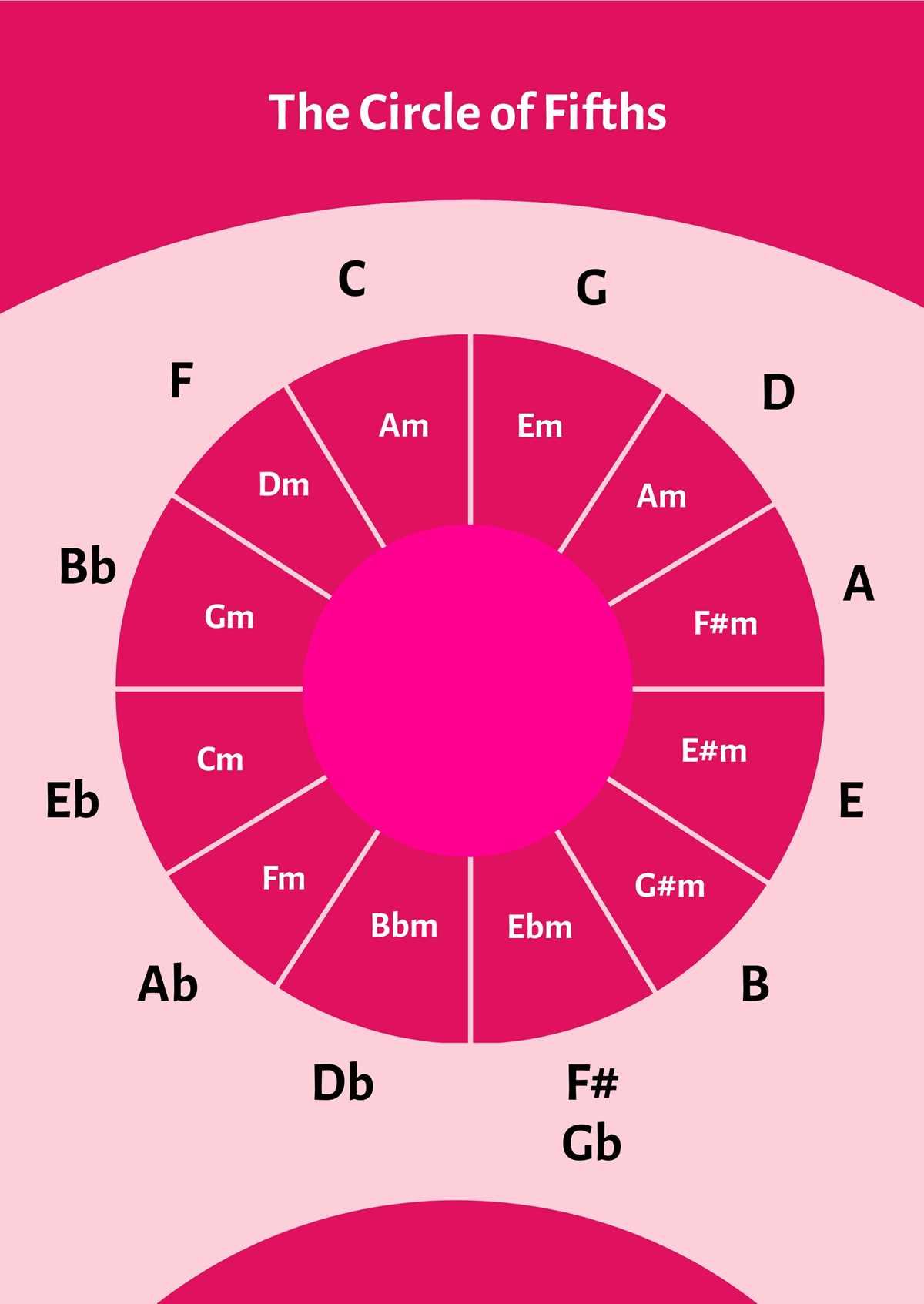
If you prefer a tailored approach to learning, create your own diagram based on your musical needs. You can include additional notes, such as the intervals between the keys or even extra annotations for specific instruments. To create a custom reference chart, simply use online tools or music software to design the diagram, or hand-draw one with the key signatures arranged in the typical clockwise pattern.
Once your diagram is ready, print it out and hang it where you practice. This visual aid will not only reinforce your understanding of key signatures but will also help you quickly transpose music into different keys when necessary.
Using the Diagram for Practice and Performance
When practicing new pieces of music, refer to the diagram to help identify the key signatures. This quick visual reference will improve your ability to recognize different tonalities while reading music. Similarly, if you are performing in an ensemble or with other musicians, having a solid understanding of how key signatures change will ensure smoother transitions between sections of a piece or when improvising.
Guide to Using a Key Signature Diagram
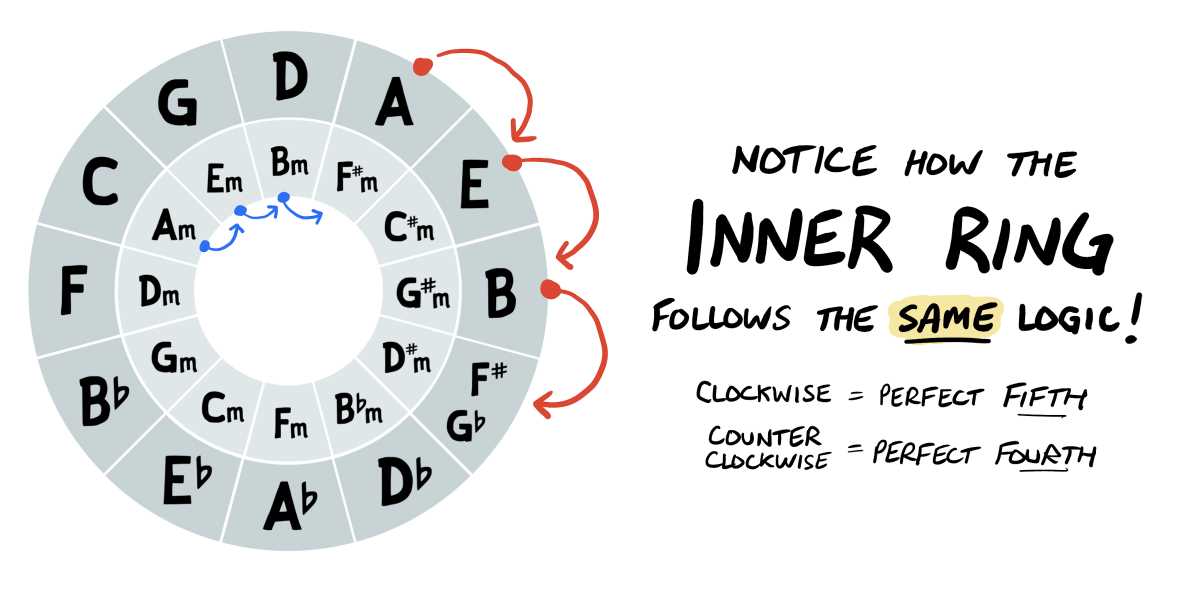
To get the most out of a key reference chart, it’s important to start by understanding its layout. The chart typically arranges major key signatures in a circular fashion, with each key moving one step forward or backward depending on whether you’re dealing with sharps or flats. To use the diagram effectively, focus on recognizing the relationships between the keys and their respective signatures. As you move clockwise, the number of sharps increases. Conversely, moving counterclockwise adds flats.
Each position on the diagram represents a different musical key. Starting from C major (which has no sharps or flats), moving clockwise adds one sharp for each step until you reach F-sharp major. Similarly, moving counterclockwise from C major adds one flat for each step until you reach B-flat major.
Understanding these key relationships can significantly improve your ability to transpose music. For instance, if you need to transpose a piece from C major to G major, simply refer to the diagram and notice that G major is one step clockwise from C major, meaning it has one sharp. This visual reference can help you adjust music quickly and accurately without needing to rely on memory alone.
As you practice using the chart, you’ll also notice that each major key has a corresponding relative minor. This relationship is vital for musicians who are learning to navigate different keys in both major and minor tonalities. The relative minor of a key can be found by counting down three semitones from the major key’s tonic. For example, A minor is the relative minor of C major, and D minor is the relative minor of F major.
For musicians looking to deepen their understanding of harmony, this diagram also provides insight into key modulation. By observing how keys are arranged around the circle, you can quickly identify keys that are closely related and could be easily modulated into. This is especially useful for composers or performers who want to create smooth transitions between sections of a piece.
In addition to key signatures, the diagram can also help with understanding the harmonic functions of each key. For example, the tonic, dominant, and subdominant chords in each key can be quickly mapped out using the diagram, making it a great tool for both composition and improvisation.
To make your practice more effective, create a personalized reference chart with additional annotations that are specific to your instrument or style of music. This could include key relationships that are particularly relevant for your practice, such as commonly used progressions or specific scales that you are working on.
Having a physical or digital version of this key reference chart accessible during practice sessions is highly recommended. Whether you’re composing, transposing, or simply exploring new musical ideas, the diagram serves as an indispensable tool that can speed up your learning process and deepen your understanding of key relationships in music.