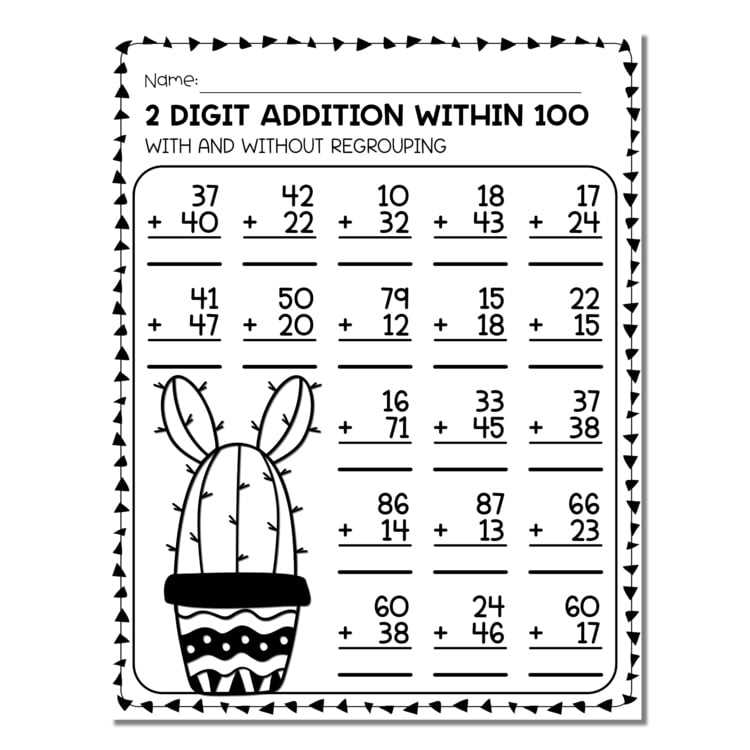
Quick Addition and Subtraction Drills
Focus on practicing simple sums and differences using numbers within the range of 1 to 20. Set up challenges that encourage rapid recall. For example:
- What is 7 + 9?
- Subtract 5 from 15.
- How much is 12 + 3?
- What is 17 – 8?
These exercises improve mental math abilities and speed. To reinforce skills, use visual aids such as number lines or counters to help visualize calculations.
Patterns with Numbers
Introduce the idea of identifying numerical patterns. For instance, work with skip counting by 2s, 5s, or 10s. This method strengthens understanding of sequences and helps with multiplication concepts later on. Examples to practice:
- Count by 2s: 2, 4, 6, 8, 10…
- Skip count by 5s: 5, 10, 15, 20, 25…
- Skip count by 10s: 10, 20, 30, 40, 50…
Ask learners to identify the missing number in a sequence to boost their problem-solving skills.
Word Problems for Applied Practice
Engage learners with simple word problems. Craft scenarios that require addition or subtraction. These scenarios make math more relatable and help build logical thinking. For example:
- Sarah has 8 apples. She buys 4 more. How many apples does she have now?
- A toy store sells 12 toys. If 5 toys are sold, how many are left?
- There are 10 cookies. If 3 are eaten, how many remain?
By solving word problems, students understand how to apply operations to everyday situations, making them more comfortable with math concepts.
Engaging Exercises for Young Learners
Focus on simple addition and subtraction exercises. Use problems with small numbers that students can work through quickly, enhancing their confidence and speed. For instance, a set of 20 problems where numbers range from 1 to 20 is ideal. Group them in patterns that help the learner identify quick strategies, such as adding 1 to even numbers or subtracting 1 from odd ones.
Introduce visual aids like number lines or base-10 blocks. These help make abstract concepts more tangible. Encourage learners to trace numbers on these lines, visualizing addition or subtraction as moving forward or backward.
Incorporate word problems based on everyday scenarios. This makes calculations relatable and fun. For example, “If you have 5 apples and buy 3 more, how many apples do you have now?” These scenarios allow children to connect math with real-life situations, reinforcing understanding.
Offer puzzles that involve grouping and sorting. For example, ask children to categorize numbers into odd or even, or arrange them in ascending or descending order. These activities sharpen sorting skills while reinforcing numerical concepts.
Practice multiplication using repeated addition. Start with lower numbers and progressively introduce larger ones. For example, show that 3 times 2 is the same as 2+2+2. This helps solidify the concept before introducing more abstract multiplication facts.
Introduce basic geometry through shape recognition. Ask children to draw and name common shapes like triangles, squares, and circles. Once they become familiar with these, you can explore symmetry and simple measurements, like comparing the size of two shapes.
Lastly, make learning fun with interactive quizzes or timed challenges. A sense of friendly competition can motivate learners to solve problems more quickly, giving them a chance to build both accuracy and speed over time. Tailor these quizzes to ensure they remain challenging but achievable.