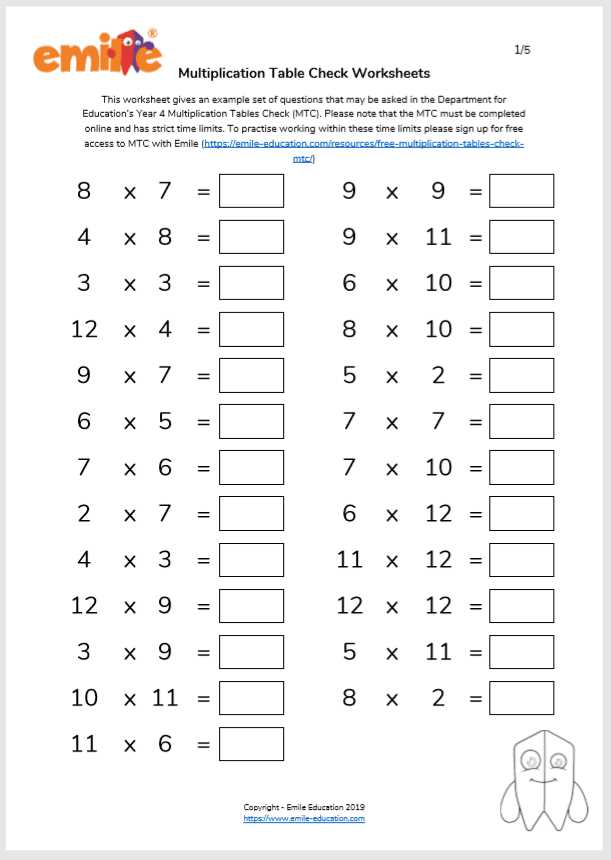
To improve math fluency, practicing basic number operations regularly is key. One effective way to do this is by using worksheets that test and reinforce the knowledge of times tables. You can easily find exercises that focus on single-digit numbers, helping young learners build a strong foundation.
Start by focusing on simple multiplication problems that challenge students to recall facts quickly. Exercises should be designed to gradually increase in difficulty, from multiplying numbers 1-5 to progressing to higher multiples. Printable worksheets with clear layouts and consistent formatting offer students a focused practice space.
By regularly practicing these problems, students can develop both speed and accuracy, which are crucial for later mathematical concepts. The best worksheets not only test basic skills but also engage children with fun, themed designs to keep them motivated. This method encourages repeated exposure, helping students commit times tables to memory more easily.
How to Create a Fun and Challenging Math Test
To create an engaging test that challenges students’ knowledge of basic number operations, begin by focusing on small numbers. Start with the most commonly used facts, such as 2s, 5s, and 10s, which students typically master first. Once these are solid, introduce larger numbers, like 6-9, to help strengthen their multiplication recall.
When designing the layout of the quiz, ensure that the questions are clear and straightforward. Avoid unnecessary decorations that may distract from the focus of the activity. Numbered lists are ideal for helping students see their progress, and space between each problem allows for easier writing and calculations.
For more advanced learners, include more complex operations such as multiplying by double-digit numbers. You can even add word problems to incorporate real-world scenarios that require multiplication, testing not just memorization but also practical application of these skills.
Consider providing a timer during the test to encourage speed. Speed is an important factor in mastering basic math facts and developing fluency. Students should aim to complete the problems within a certain timeframe, which also prepares them for timed classroom activities or standardized tests.
Another helpful feature is to include both vertical and horizontal problems. This will help students adapt to different formats and see the equations from different perspectives. Some learners may find vertical problems easier to solve, while others may perform better with horizontal questions.
In addition to regular tests, offering incentives for improvement can boost motivation. Track students’ progress over time and celebrate their achievements, no matter how small. This keeps the experience positive and makes math feel more rewarding.
To add variety and make the tests more fun, you can offer themed worksheets based on holidays or popular interests. For instance, you can design tests that feature elements like animals, sports, or outer space to capture the imagination of younger students.
Lastly, it’s crucial to review the results with each student. Discuss common mistakes and reinforce the correct methods for solving multiplication problems. Encourage them to work on areas where they struggle, and provide additional resources to practice at home or in class. Continuous review will help students retain their skills and build confidence in their mathematical abilities.
How to Create a Multiplication Practice Quiz
To create a focused quiz, start by selecting a specific number range for students to practice. Begin with simple facts such as 1-5 and gradually increase the difficulty by introducing higher numbers as students improve. For example, once the basic facts are solid, you can move on to operations involving larger numbers like 12 or 15.
Ensure that the format is straightforward. Use a grid or a set of equations that challenge learners to recall facts quickly. For beginners, you might focus on one number at a time, such as only testing the 2s or 3s. As proficiency increases, expand the scope to include multiple numbers in the same quiz, ensuring it matches the learner’s current level.
Another key element is providing space for learners to show their work. This encourages the development of proper mathematical habits and allows for reviewing methods later. Make sure there is a mix of direct calculation questions and problem-solving scenarios where students need to apply their knowledge in context, like determining the total cost of multiple items based on price.