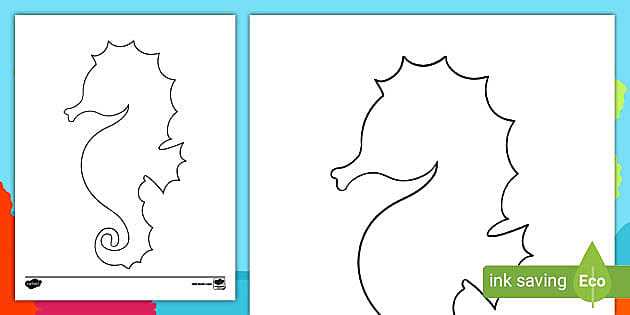
Download a clean black-and-white line drawing in A4 or US Letter size at 300 DPI, with margins of at least 10 mm to avoid clipping during home printing. Choose a simple contour for preschoolers and a detailed marine horse silhouette with textured fins for older students.
Selecting the Right Template Format and Detail Level
Use PDF files for consistent scaling and sharp edges. Set printing to 100% scale and disable “fit to page” to keep proportions accurate. For classroom sets, prepare three variations:
- Basic contour with thick 2–3 pt lines for crayons and markers.
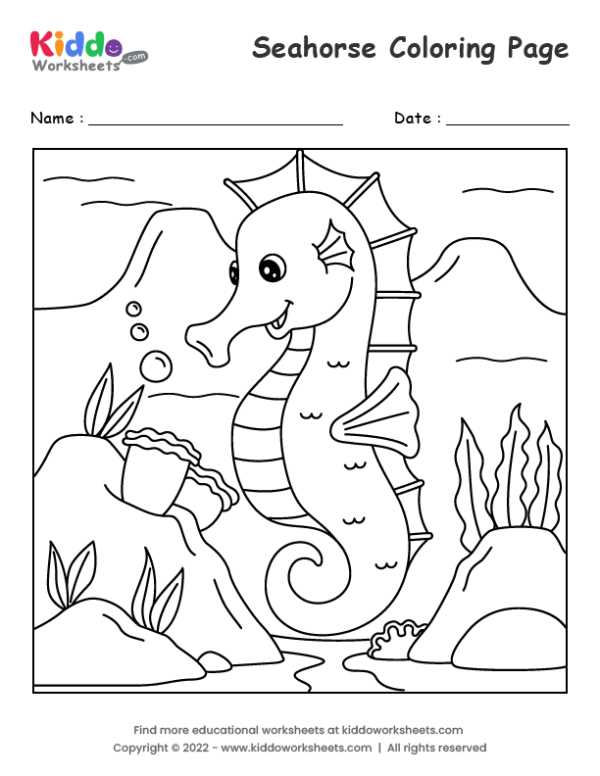
- Medium-detail sketch including fin rays and body segments for colored pencils.
- Advanced line art with small patterns for watercolor practice.
Keep the figure height between 12–18 cm for individual worksheets. For wall displays, enlarge to 25–30 cm and print on 160–200 gsm cardstock to prevent wrinkling.
Practical Uses for Marine Horse Silhouette Sheets
Coloring and Fine Motor Practice
Provide reference images of real species to guide color choices. Encourage shading from light to dark along the curved torso. Use cotton swabs for stippling texture on the belly and tail.
Cut-and-Paste Ocean Crafts
After coloring, cut along the contour and mount on blue construction paper. Add seaweed strips from green paper and glue small beads as bubbles. For a 3D effect, attach the figure with foam tape.
Educational Activities
Label body parts such as snout, dorsal fin, and curled tail. Create a matching worksheet where students connect terms to the correct area on the marine creature drawing. For older grades, assign a short paragraph describing habitat and diet next to the image.
- Print on standard 80 gsm paper for coloring tasks.
- Use heavier stock for craft projects.
- Store digital files in both PDF and PNG formats for flexibility.
Keep files organized by size and complexity level so teachers and parents can quickly select the appropriate sea creature sketch for each activity.
Seahorse Outline Printable
Download a high-resolution line drawing of this marine horse at 300 DPI in PDF format and print it at 100% scale to keep proportions accurate and details sharp.
Choose thick 2–3 pt black lines for preschool use; bold contours help children stay within borders while coloring with crayons or broad-tip markers.
For grades 2–5, select a refined contour version that includes segmented body plates, fin rays, and a curled tail spiral. These added elements support pencil shading, cross-hatching, and texture exercises during art lessons.
Set margins to at least 0.4 inches on all sides to prevent trimming of the snout or dorsal fin. Use standard 80 gsm paper for coloring sheets and 160–200 gsm cardstock for cut-and-paste crafts or classroom displays.
Adjust figure height between 15 and 18 cm for individual worksheets; enlarge to 25 cm for bulletin boards. Keep aspect ratio locked when resizing to avoid distortion of the curved torso.
Store files in both PDF and PNG formats. PDF maintains clean vector edges for repeated printing, while PNG at 2480×3508 px (A4 at 300 DPI) allows quick insertion into digital lesson plans.
Pair the sea creature sketch with factual prompts such as labeling the snout, eye, brood pouch, and prehensile tail. This approach connects art practice with marine biology content.
Organize templates by difficulty level and intended activity–coloring, cutting, labeling, or painting–to save preparation time and match each worksheet to student skill level.