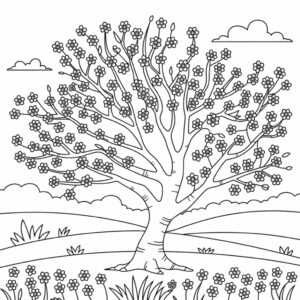
Select high-resolution black-and-white forest illustrations in PDF format with a minimum of 300 DPI to ensure sharp outlines on standard A4 or US Letter paper. Choose designs with clean vector lines and wide contours so crayons, markers, or colored pencils do not bleed beyond edges.
Download artwork files sized at 8.5 x 11 inches or 210 x 297 mm and check that margins are at least 0.5 inches to prevent trimming during home output. For younger children, pick simple oak, pine, or palm silhouettes with large open sections; for older kids or adults, select detailed woodland scenes with bark texture, leaves, and seasonal elements.
Use standard 80–100 gsm paper for crayons and pencils, and switch to 120–160 gsm stock for markers or light watercolor to reduce warping. Activate “actual size” in the print dialog to keep proportions accurate, especially if the design includes symmetrical branches or patterned foliage.
Create themed sets such as spring blossoms, autumn foliage, and winter evergreens to match lesson plans or craft sessions. Organize downloaded files in labeled folders by difficulty level and season so you can quickly access the right woodland artwork for classroom activities or home projects.
Where to Download Free Printable Tree Coloring Pages in High Resolution PDF
Download high-resolution woodland outline sheets from educational resource platforms that provide PDF files at 300 DPI or higher and specify exact dimensions such as 8.5 x 11 inches or A4. Check the file details before saving to confirm vector format or sharp raster quality suitable for home or school printers.
Use teacher resource libraries and homeschooling websites that categorize nature-themed line art by difficulty level. Many offer oak, birch, pine, and tropical plant silhouettes as downloadable documents with clearly marked licensing terms for classroom and personal use. Prioritize collections that include preview images and file size information above 1 MB to ensure adequate detail.
Stock image platforms with public domain artwork sections also provide botanical drawings scanned at high resolution. Search using keywords like “forest outline PDF 300 DPI” or “botanical line art A4 download” to filter results. Confirm that margins are built into the layout so no branches or leaves are cut off during output.
Open educational repositories and museum digital archives often host vintage botanical illustrations converted into clean black-and-white sheets. Choose files labeled as scalable vector graphics or high-quality PDF to maintain crisp edges when printed on standard or heavyweight paper.
How to Print and Use Tree Coloring Pages for Seasonal Crafts and Classroom Activities
Select a high-resolution botanical outline in PDF format and set the printer to 100% scale with “actual size” enabled to avoid distortion of branches and trunk proportions. Use 120–160 gsm paper for markers and paint, and switch to 200–250 gsm cardstock when the design will be cut out and mounted on display surfaces.
Adjust output settings based on the medium:
- Black ink only mode for sharp contour lines and lower toner use.
- Grayscale disabled to keep lines deep and easy to see.
- Borderless option off to prevent trimming of outer elements.
- Manual feed tray for thicker sheets.
Organize activities by season using the same woodland silhouette template. Add green tissue squares and cotton balls for spring foliage, sponge-paint red and orange tones for autumn canopies, glue white paper scraps for winter snow effects, and attach small paper blossoms for warm-weather themes. Laminate one master copy to reuse as a tracing base.
In group settings, divide learners into stations:
- Shading and texture practice using colored pencils and crosshatching.
- Scissor skills station cutting along outer contours.
- Background creation with watercolor washes on separate sheets.
- Assembly corner where cut shapes are glued onto mural paper.
Store finished artwork in labeled folders sorted by season and technique to track progress in fine motor control and color blending. Use dated labels to compare improvements in line precision and filling accuracy over several weeks.
Mount completed pieces on large poster backing with double-sided tape spaced every 5–7 cm to prevent curling. Position elements at varying heights to create depth, and leave at least 2 cm between shapes so individual work remains visually distinct during classroom exhibitions.